The KRW/USD exchange rate is more than just a conversion ratio between foreign and domestic currency; it is one of the most sensitive indicators for gauging a nation's economic health. While many people tend to think that a rising exchange rate is always bad and a falling one is always good, the impact in real economic terms is highly complex. In certain situations, a rising exchange rate can be an opportunity for export companies, while a falling rate can help stabilize import prices and ease the burden on households. Therefore, when looking at exchange rates, it is necessary to have the insight to read the current state of our economy and the flow of the global market, rather than being swayed by short-term fluctuations in figures.
Why does the KRW/USD exchange rate keep changing?

Exchange rates are fundamentally determined by supply and demand in the foreign exchange market. In countries with high export dependency like South Korea, the exchange rate tends to fall when the volume of dollars coming in from export proceeds increases. Conversely, the rate rises when foreign capital leaves or when demand for dollars surges to pay for raw material imports. These factors are compounded by U.S. interest rate policies, global geopolitical risks, and the monetary policy of the Bank of Korea.
Recently, as uncertainty in global financial markets has increased, there has been a frequent preference for the dollar as a safe-haven asset. During such times, even if the fundamentals of the Korean economy are solid, the exchange rate often fluctuates sharply due to external factors. What readers should focus on is distinguishing whether these external factors are temporary or part of a long-term trend. If the fluctuation is due to a temporary supply-demand imbalance, it is likely to stabilize through policy responses; however, if it is caused by structural economic changes, a new benchmark for the exchange rate may be formed.
International interest rate differentials are also a critical variable. When the U.S. Federal Reserve raises interest rates, the yield on the dollar increases, causing capital to flow toward the U.S. In this process, the Korean Won faces downward pressure, and the exchange rate rises. Conversely, if the Bank of Korea maintains high interest rates or shows a tightening stance, Won-denominated assets become more attractive, which acts as a factor for a lower exchange rate. This capital movement driven by interest rate gaps is one of the most direct and powerful drivers of exchange rate volatility. In practice, exchange rates are also closely related to forecasts for each country's economic growth rate. If a country's economy is expected to grow rapidly, foreign capital flows in, leading to an appreciation of that country's currency.
What impact does a rising exchange rate have on my wallet?

The first thing felt when the exchange rate rises is the cost of imports. Most of the crude oil, grain, and semiconductor components we use in our daily lives are paid for in dollars. When the exchange rate rises, we must pay more Won for the same goods, leading to 'import inflation,' which naturally raises domestic prices. This has the effect of reducing the real income of households and is a primary cause of higher perceived inflation, as it leads directly to increased energy costs and food prices.
On the other hand, for those planning overseas travel or sending money for children's tuition, a rising exchange rate acts as a direct financial burden. Conversely, during periods of a falling exchange rate, the price competitiveness of imported products increases, contributing to price stability; however, it may also weaken the price competitiveness of domestic exporters, potentially having a negative impact on employment or profitability across industries. In reality, while a rising exchange rate may improve profitability for companies by increasing export price competitiveness, the counter-effect of increased raw material import costs means the net impact varies by sector. For example, manufacturing industries heavily dependent on raw materials may see profitability worsen due to higher production costs, whereas finished-goods exporters may enjoy increased revenue.
3 points investors should check during periods of exchange rate volatility
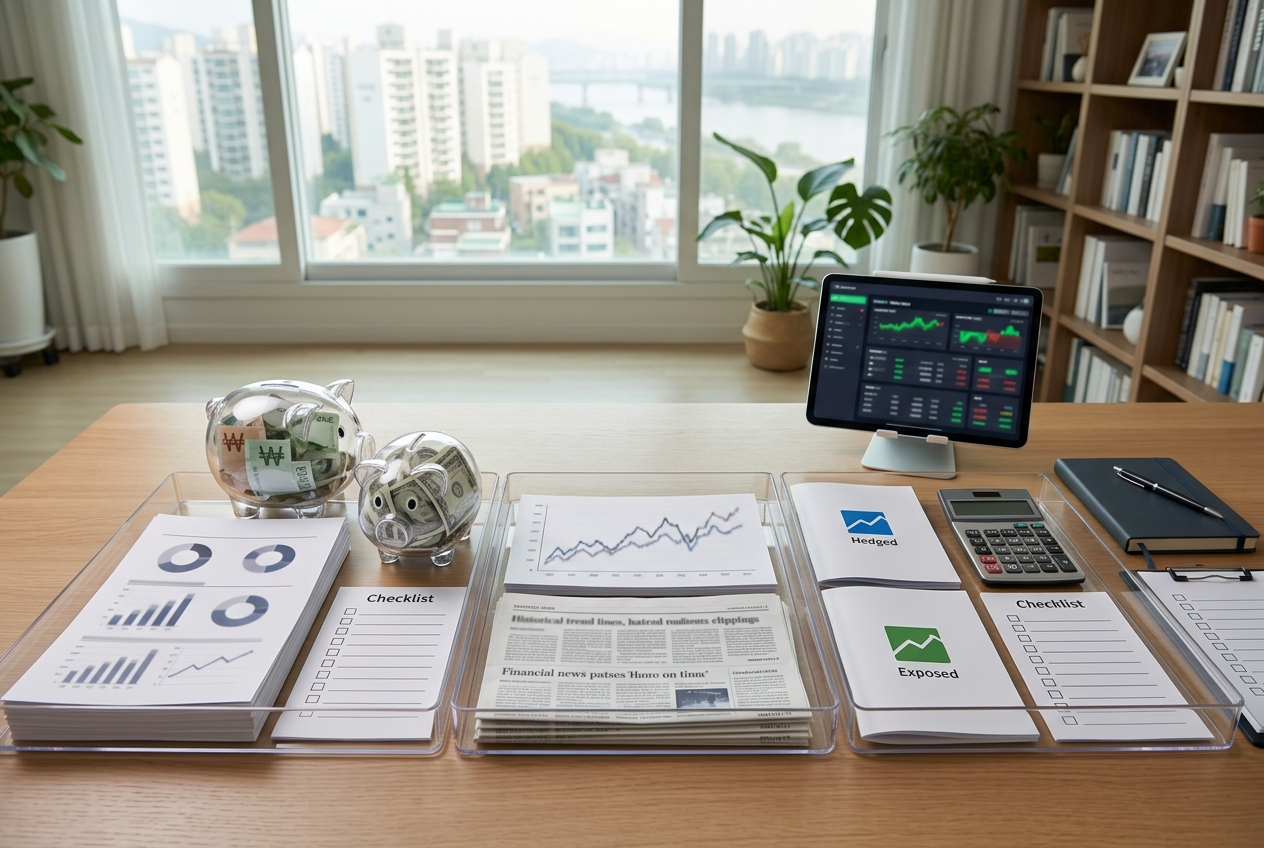
Investors should not view the exchange rate merely as a market outcome, but as a signal to reorganize their portfolios. First, check how much your assets are exposed to the dollar versus the Won. Second, identify patterns through historical data on how the value of the dollar changes during concerns of a global economic downturn. Third, understand exchange rate volatility itself as an asset class and prepare risk-hedging measures.
When setting an investment strategy, try using the following checklist:
- Is the proportion of dollar assets in my current portfolio appropriate?
- Do I distinguish between sectors that benefit from a rising exchange rate and those that are harmed?
- Have I secured cash flow to withstand exchange rate volatility?
- If I have foreign currency debt, have I calculated the increase in interest costs due to a rising exchange rate?
- Have I set the rebalancing cycle of my portfolio in line with exchange rate volatility?
Furthermore, when considering asset allocation to respond to exchange rate volatility, it is essential to clearly understand the difference between 'currency-exposed' and 'currency-hedged' products. Currency-exposed products reflect exchange rate fluctuations directly in asset returns, making them advantageous during periods of a strong dollar, while currency-hedged products remove the effect of exchange rate fluctuations, allowing you to focus solely on the intrinsic value changes of the assets. Depending on whether your investment goal is short-term profit or long-term asset protection, you need the wisdom to appropriately allocate these two types of financial products.
Is it possible to predict exchange rates?

Many experts try to predict exchange rates, but the exchange rate is a complex system intertwined with countless variables. Therefore, a scenario-based approach—asking 'in which direction is the exchange rate likely to move'—is far more effective than trying to hit an exact figure. For example, it is important to understand the logical causality that if the U.S. Federal Reserve signals a clear interest rate cut, the KRW/USD exchange rate will face downward pressure. Key variables to consider when predicting exchange rates include the size of the trade surplus/deficit, trends in foreign investment in domestic stocks and bonds, and changes in national credit ratings.
Rather than blind prediction, the key to wise financial life is to grasp the market consensus and plan in advance how to respond if that consensus is broken. In particular, individual investors are safer choosing to mitigate the impact of exchange rate fluctuations through long-term asset allocation strategies rather than trying to profit from short-term volatility. Instead of pouring too much energy into predicting exchange rates, it is more constructive to study macroeconomic trends and perform stress tests to see how much your portfolio can withstand external shocks. Also, be aware that the possibility of market intervention by the government or the central bank can be a significant turning point that changes the flow of the exchange rate.
What are the alternatives for responding to exchange rate volatility?
If you are concerned about exchange rate fluctuations, you can naturally manage currency exposure through foreign currency deposits, dollar ETFs, or diversified investments in overseas stocks. Buying dollars unconditionally is not the only answer. It is important to regularly adjust (rebalance) the ratio of dollar assets to Won assets according to your consumption patterns and future financial plans. Foreign currency deposit products at commercial banks can be a good way to aim for both interest income and exchange gains, but be careful that exchange fees do not erode your returns. Recently, many financial services offer preferential exchange rates when signing up for foreign currency deposits, so it is recommended to take advantage of these.
Additionally, various financial products such as mobile apps that allow dollar investments with small amounts or foreign currency RPs have been released. By using these tools, you can respond to exchange rate changes in real-time without having to visit a bank branch as in the past. However, regardless of the product you choose, it is essential to carefully check the fee structure, maturity date, and whether it is covered by deposit insurance. Remember that the core of asset management is not to maximize profit, but to protect the value of assets while diversifying the risks of inflation and exchange rate fluctuations. Diversified investment is not just about spreading money across multiple products, but about combining assets with different sensitivities to exchange rates to lower the overall volatility of your portfolio.
Ultimately, the exchange rate is a mirror of the economy. Rather than the fact that the exchange rate is high or low at a certain point in time, you need to make an effort to understand the background of why such an exchange rate level was formed. When watching economic news, instead of worrying about how high the exchange rate will go, observe how the current exchange rate level is changing your household's spending power and the business environment for companies. Continuous learning and calm responses are the only ways to safely protect your assets in a rapidly changing global economic environment. While the financial market has many unpredictable variables, if you grasp the basic principles and the flow of the economy, you can maintain your composure and establish the right asset management strategy even in a rapidly changing environment.
Financial decisions should always be based on an individual's financial situation and goals. This content is general economic information; for actual investment or asset management, please consult with an expert or check materials from reputable financial institutions.
Frequently Asked Questions
Is a rising KRW/USD exchange rate always bad?
No, that is not the case. A rising exchange rate can increase the price competitiveness of export companies, contributing to revenue growth. However, the downside is the increased burden on households due to rising import prices.
How can I prepare for exchange rate fluctuations?
It is recommended to diversify your portfolio by holding a portion of your assets in dollar-denominated assets or investing in financial products that can mitigate exchange rate risk.
How is the exchange rate determined every day?
The price is determined at the equilibrium point of supply and demand as buy and sell orders for dollars from participants in the foreign exchange market are executed in real-time.
Where can I find exchange rate forecast information?
You can check the overall market outlook through reports from major economic research institutes, foreign exchange analysis materials from commercial banks, and economic news channels.