After writing a cover letter—the first gateway to employment—you often feel uncertain about whether it will appear attractive to recruiters. Simply filling in the character count or listing fancy sentences is not enough. Before hitting the submit button, there are strategic points you must verify. In this article, we have compiled the essential items you need to check to ensure your cover letter is a high-quality result.
The first thing to check when writing a cover letter is whether your answer aligns with the intent of the question. A common mistake many applicants make is listing their experiences without grasping the core of the question. For example, in a section asking for 'problem-solving skills,' many applicants describe the problem situation at length but omit the specific actions they took and the results they contributed. You must re-identify the competencies required for each question and ensure those competencies are clearly embedded in your answer. To verify if you have accurately understood the question, it helps to practice rewriting the question's keywords into a sentence. If the question is about 'collaboration experience,' your answer must clearly reveal the definition of collaboration and your role within it. Instead of simply saying 'we worked hard together,' you should specifically describe 'how you mediated conflicts' or 'what communication methods you used.'
Checking the Link Between Job Competencies and Experience

A cover letter is not a novel; it is a document that proves your ability to perform a job. Therefore, it is essential to connect how your experience can provide value in that specific role. Rather than just stating you 'worked hard,' you must logically explain how the knowledge and skills gained through that experience can be applied to the job after joining the company.
Checklist: Does your experience connect precisely with the core competencies of the job you are applying for (e.g., data analysis, communication, problem-solving, etc.)? Are specific figures or results provided to increase credibility? When describing experiences, it is recommended to use the STAR (Situation, Task, Action, Result) technique to structure them systematically. The key is not just to list past facts, but to create a link showing how that experience can help create performance in the current role. You should conduct job analysis beforehand and appropriately weave the competency words required by the company into your experience description. For example, for a marketing role, it is better to present 'data-driven decision-making experience' with specific examples, and for a sales role, 'strategic approaches to achieving goals.'
Also, even if your experience does not perfectly match the job, you need to practice extracting 'Transferable Skills.' Even part-time jobs or club activities involve responsibility, time management, and problem-solving processes that can be directly applied to the workplace. What matters here is not the fact itself, but emphasizing what kind of professional attitude the applicant developed through that fact. Recruiters try to predict future work performance through an applicant's past experience. Therefore, all experiences must be reinterpreted from the 'perspective of the job.'
Sentence Structure and Editing to Improve Readability
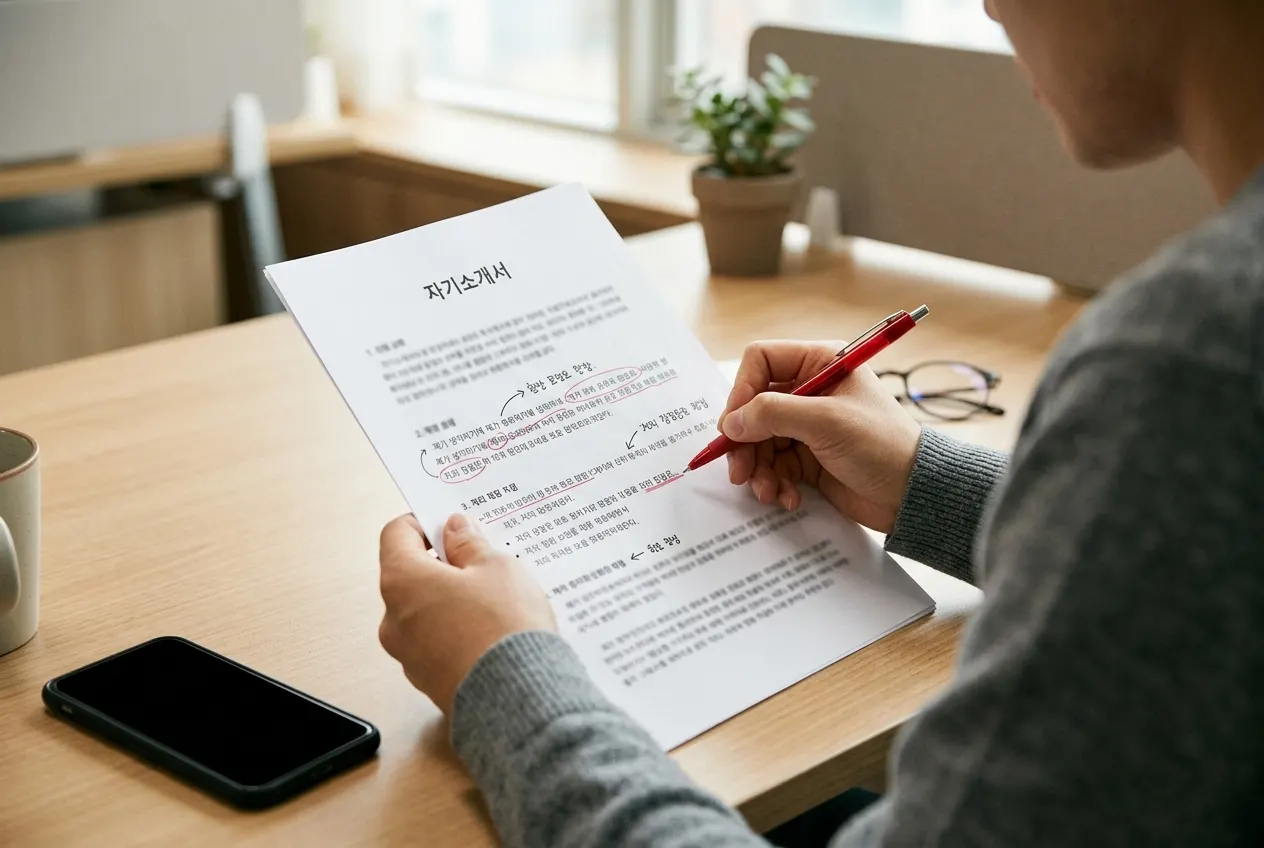
Recruiters read countless cover letters. Long sentences reduce readability and hinder the grasp of key points. Sentences should be short and concise, and a deductive structure (stating the conclusion first) should be the default. Using subheadings appropriately helps recruiters scan the content quickly.
The following is a comparison table for improving readability.
| Category | Writing to Avoid | Writing to Aim For |
|---|---|---|
| Sentence Length | Listing 3-4 facts in one sentence | Conveying only one core point per sentence |
| Structure | Inductive (conclusion at the end) | Deductive (conclusion at the beginning) |
| Subheadings | Not using them or writing just 'Experience' | Using sentence-style headings that summarize core competencies |
As shown in the table above, simply refining your sentences can significantly change your delivery. In particular, subheadings should go beyond summarizing content and serve to show the core message of the entire paragraph in advance. The connectivity between paragraphs is also important. Each paragraph should be arranged so that they flow organically, like a single story of your competencies. Furthermore, you need to boldly delete unnecessary conjunctions or modifiers to make your sentences sharper. For example, starting a sentence with 'My strength is...' instead of 'I think my strength is...' carries much more weight.
You should also consider visual layout within paragraphs. Paragraphs that are too long cause fatigue for the reader. Readability improves dramatically if you organize the layout, such as using bullet points for important content or emphasizing key sentences. Using line breaks appropriately to control the pace is also a good editing strategy. Making it easy for the reader to follow the content is the core service spirit of writing a cover letter.
Checking for Logical Gaps and Typos

The most basic yet surprisingly overlooked part is typos and ungrammatical sentences. These serve as a yardstick for judging diligence and meticulousness. Using a spell checker is essential, and reading it aloud is also a good method. You can immediately feel the awkwardness in parts where the context is not smooth when reading aloud.
You must also check for logical gaps. Check if there is a logical bridge between the fact that 'you did a certain activity' and the conclusion that 'therefore you have the competency.' If you jump to the conclusion with the intermediate process omitted, your persuasiveness drops. For example, jumping directly from 'I did volunteer work' to 'I developed leadership' can be a logical gap. The specific process of what conflicts you faced during the volunteer work and how you communicated to resolve them must accompany it for the conclusion of 'leadership' to gain validity. For logical completeness, keep asking yourself 'why' as you review your writing. The clearer the answers to 'Why did I take this action?' and 'Why did this result occur?' are, the more solid your writing becomes.
Also, you must check the logical validity of narrowing the gap between the competencies you possess and the competencies the company requires. Companies ask why you are suitable for them. At this time, rather than a listing-style answer like 'I am this kind of person,' you need a logical connection like 'Our company has this direction, and since I also pursue this direction, we can create the best synergy.' Do not forget that each section of the cover letter is not an independent piece of writing, but a giant puzzle piece proving your job competencies and values.
Criteria for Judging Suitability by Situation
What you need to emphasize varies depending on the industry and job characteristics of the company you are applying to. More conservative companies prefer organized vocabulary and polite tone, while startups or creative roles are more effectively served by emphasizing specific achievements and a spirit of challenge. Check the company's talent philosophy once more through their website or recent press releases, and perform a final check to see if keywords matching those values are included. The effort to understand the company's recent issues and think about how to connect them with your experience leaves a deep impression on recruiters.
There are also differences by industry. IT service roles value technical understanding and fast learning ability, while sales management roles value interpersonal skills and persistence in achieving goals. It is important to consider these industrial specificities when deciding how to package your experience. Rather than just saying 'I worked hard,' a descriptive style like 'I put in this much effort to achieve this result, and in that process, I realized the values the company pursues' is much more effective. Also, connecting the company's mission or vision with your own values makes your motivation for applying more sincere.
Final Cover Letter Checklist
Just before submitting, please check the following items again: 1) Are the core keywords needed for the job included? 2) Did you specify your concrete role and contribution when describing experiences? 3) Are the sentences concise rather than too long? 4) Is the company name written correctly, and are there any typos? 5) Do the subheadings represent the content well? 6) Did you comply with the character limit? 7) Is the motivation for applying specific and sincere? Finally, don't forget to convert to PDF before submitting to ensure the layout doesn't break. Complying with regulations regarding file format or submission method is also a basic attitude for an applicant.
A cover letter is not completed in one go. After writing a draft, you need a process of setting it aside for about a day and reading it again. Looking at your writing from an objective perspective and trimming unnecessary modifiers is the shortcut to speeding up your acceptance. It is also good to show it to people around you and get feedback. If you check how the writing is read from others' perspectives, you can correct logical flaws you hadn't discovered. Until the end, clearly reveal your strengths, and reflect once more on how those strengths can contribute to the job you are applying for, then submit with confidence.
Frequently Asked Questions
Why is a deductive structure important in a cover letter?
Recruiters review numerous documents, so they prefer a structure where they can quickly grasp the core. Presenting the conclusion first clarifies the direction of the writing and can increase the reader's focus.
I lack experience, how should I emphasize my competencies?
More important than the quantity of experience is the interpretation of what you learned and how you grew through that experience. Even if it is a small experience, focus on describing the problem-solving process related to the job.
Are subheadings necessary?
They are not mandatory, but subheadings greatly increase the readability of the writing. It is recommended to use them because they allow the recruiter to grasp the content in advance and spark interest in the writing.
Does one typo have a big impact on acceptance?
Typos are an indicator of an applicant's meticulousness and interest in the company. It can be fatal, especially if the company name is written incorrectly, so you must review it several times before submitting.