For those considering home ownership, it is often said that housing subscription is not an option but a necessity. However, when you actually try to sign up, you may find yourself wondering where to start or how much to deposit each month. A housing subscription is not just a savings account; it is like a qualification certificate to gain the right to move into government-designated housing. From a long-term perspective, a subscription account is the starting point for asset formation and a powerful tool to ensure future housing stability. Since the subscription system is operated for housing welfare, signing up early to secure points for the subscription period itself becomes a significant asset.
Selection Criteria to Consider Before Signing Up for Housing Subscription

Your strategy for housing subscription should change completely depending on your housing plans and economic conditions. The first thing to check is the type of housing you intend to apply for. If you are targeting public housing, the number of payments and the total amount are important; if you are targeting private housing, meeting the regional deposit requirements is key. Rather than blindly starting based on the advice that 'signing up early is good,' you should first define what type of housing you hope to live in within the next 5 years. You must calculate your savings capacity relative to your income and set clear priorities on whether to fulfill the 'number of recognized payments' for public housing or secure the 'deposit' for private housing.
A common mistake many people make is regarding the 'payment amount.' While it is widely known that paying 100,000 KRW per month consistently is advantageous for public housing, private housing is different. For private housing, you only need to have the regional deposit amount in your account by the date of the tenant recruitment announcement. Therefore, identifying your priorities is the first step in making a choice. Especially for young professionals, it is important to activate the account by paying at least a minimum amount consistently, even if your income is low, and to take a flexible approach by adjusting the payment amount as your economic situation improves in the future.
Understanding the Subscription System: Key Differences Between Public and Private

The core of housing subscription lies in clearly understanding the difference between public and private housing. Public housing is supplied by the state, local governments, or LH, and is relatively affordable but has strict conditions. The most important indicator here is the 'recognized amount of housing subscription savings.' It is important to pay on the agreed date every month, as delays or non-payments can significantly lower your chances of winning. Public housing targets heads of households who do not own a home and requires meeting both income and asset criteria, so it is good to check your income eligibility in advance. Also, since public housing often selects winners based on a non-homeownership period of 3 years or more and the number of payments, long-term planning is essential.
On the other hand, private housing is supplied by private construction companies and follows a method that combines a 'point system' and a 'lottery system' rather than just the number of payments. The non-homeownership period, number of dependents, and subscription duration are converted into points to compete. What is important here is how you manage your 'points.' A longer non-homeownership period is advantageous, and more dependents increase your points. Conversely, if you are a single-person household or have low points, you should target lottery-based units. Private housing has the advantage of offering a chance to win through lottery units even if you fail in the point system. Since the lottery system selects winners regardless of points, it is a valuable opportunity for young people or single-person households.
As such, the operating principles of the two systems are completely different. Public housing is a process of proving 'sincerity,' while private housing is a process of proving 'stability' and 'family composition.' You should decide whether to target public or private housing as your main goal by considering your current income level and asset formation plan. If you are a young professional, the safest strategy is to increase your subscription period while meeting the criteria for public housing. Keep in mind that for public housing, even if you pay more than 100,000 KRW per month, the recognized amount is capped at 100,000 KRW. On the other hand, if you are preparing for private housing, it is good to deposit the required amount for the target unit size in advance so that you are always ready to apply.
Management Strategies and Precautions by Situation
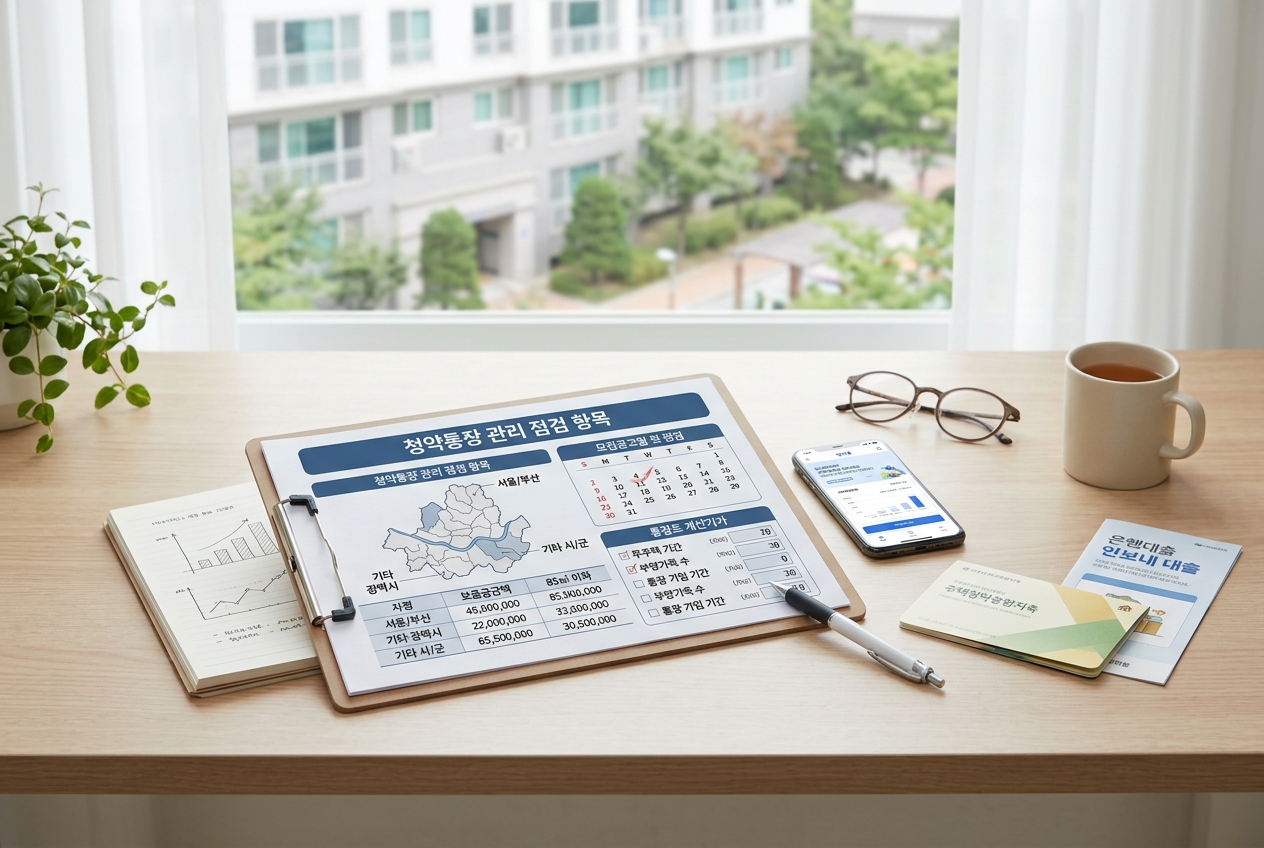
The biggest mistake in subscription management is 'early termination.' The moment you close your account because you need emergency funds, all the payment counts and subscription duration you have accumulated are reset. This is equivalent to giving up the opportunity for home ownership yourself. Remember that a subscription account is not an emergency fund account. If you inevitably need a large sum of money, it is much wiser to use a loan product collateralized by your subscription account. It is recommended to check various financial services that allow you to access urgent funds while maintaining your subscription account.
Also, you should frequently check the regional deposit amount criteria. Since the criteria for the exclusive area of the housing you want to move into or purchase may change, it is a good habit to check the status of your account at least once a year. Deposit requirements vary depending on the city (e.g., Seoul, Busan, other regions) and the unit size (85 square meters or less vs. larger). Since the deposit amount must be met by the date of the tenant recruitment announcement, you need to be meticulous about meeting the deposit requirements in advance if your target area is decided. If you are short on the deposit, you can often secure eligibility by depositing the remaining amount just before the announcement date, so please be sure to understand the regulations accurately.
You should also calculate your subscription points carefully. Sometimes, mistakes in calculating the non-homeownership period lead to disqualification. You must familiarize yourself with complex regulations in advance, such as whether you have ever owned a home and how the unmarried period before age 30 is included. By using the Apply Home website, you can simulate your points and expected chances of winning in advance. In particular, when calculating the number of dependents, whether direct ancestors own a home is a very sensitive issue, so it is essential to verify your point factors before the announcement is released. Do not forget that the period before age 30 is not included in the non-homeownership period calculation, which starts from age 30 onwards.
Checklist for Action: Things to Do Right Now
First, check if you have a subscription account, and if not, open one immediately. Second, if you hope for public housing, set up an automatic transfer of 100,000 KRW per month. Third, if you hope for private housing, check the regional deposit criteria for your area and deposit the remaining amount at once. Fourth, update your subscription-related information once a month to understand your points and eligibility requirements. Fifth, run a subscription point simulation based on your income and future asset plans. Since strategies for subscriptions can change depending on your situation, periodic information gathering determines your chances of winning.
Additional points to consider are changes in the head of household or changes in address. Since subscriptions often consider the homeownership status of all household members, the timing of household separation or changes in the head of household can be an important variable in your subscription strategy. Also, identify in advance whether you are eligible for special supply (newlyweds, first-time buyers, multi-child households, etc.) and prioritize the type that is advantageous to you, as this is a shortcut to increasing your chances of winning. Special supply often has lower competition rates than general supply, so if you qualify, you should actively utilize it.
Subscription is a long-term game, not a short-term one. Even if you don't win immediately, just maintaining the account continues to accumulate points for the subscription period. These points will become your greatest weapon later. Letting go of impatience and maintaining a consistent management attitude is ultimately the surest way to lower the threshold for home ownership. As it is a financial product, please be sure to check the official Apply Home website or the latest announcements from relevant financial institutions for specific subscription regulations. Consistent interest and systematic preparation will turn your dream of home ownership into reality. Since the subscription system is frequently reorganized according to government policy changes, efforts to carefully examine the housing measures announced every year must be accompanied. Your small efforts now will return as the great fruit of home ownership years later.
Frequently Asked Questions
How much is an appropriate monthly payment for a subscription account?
If you are aiming for public housing, a monthly payment of 100,000 KRW is most advantageous. For private housing, the deposit amount is more important than the number of payments, so prioritizing meeting the regional deposit criteria for your desired housing size is the first step.
What happens if I terminate my subscription account?
As soon as you terminate it, all the subscription duration and payment counts you have accumulated will disappear. Your subscription eligibility will be reset, so unless it is a truly urgent situation, it is better to use collateral loans or other methods.
How is the non-homeownership period calculated?
It is calculated as the period during which you maintained a non-homeownership status from the day you turned 30 until the date of the tenant recruitment announcement. If you were married before age 30, it is calculated from the date of marriage registration.
Should I choose public or private housing?
Generally, it is common for young professionals with low income and short non-homeownership periods to focus on public housing, while those with high points or some financial backing focus on private housing.