Receiving news of someone's death is one of the most bewildering and overwhelming moments in life. It is because practical issues arise even before you have had time to process your grief. However, if you understand and prepare for the procedures calmly, you can minimize the confusion faced by those left behind. Today, we will systematically examine the essential administrative procedures and options to consider following a death.
Initial Response and Essential Administrative Procedures

The first thing to do immediately after a death is confirmed is to obtain a death certificate or a post-mortem examination report. This document is the foundation for all subsequent procedures. If the death occurred in a medical institution, you must obtain it from the attending physician; if it occurred outside a hospital, you must report it to the police for an examination. Since this document is required for all processes, including death registration, insurance claims, and asset settlement, it is recommended to secure sufficient copies.
Death registration must be submitted to the local Eup, Myeon, or Dong community service center within 30 days of becoming aware of the death. Be aware that failure to meet this deadline may result in a fine. Recently, the 'One-Stop Inheritance Service' has been established, allowing you to check the deceased's assets and handle various name changes all at once, so it is efficient to make active use of this system.
A point of caution during the initial response is not to omit these administrative reports while focusing on funeral arrangements. It is recommended to obtain at least 7 to 10 copies of the death certificate. This is because many institutions, such as insurance companies, banks for account settlement, and real estate offices for title transfers, often require the submission of original documents. Furthermore, while resident registration cancellation and loss of health insurance eligibility occur automatically once the death is registered, individual utility bill name changes or subscription service cancellations must be handled directly by the bereaved family. In particular, for life-essential utilities such as telecommunications, electricity, water, and gas, if the account remains in the deceased's name, unnecessary costs may occur or service usage may be restricted. Therefore, it is advisable to go through the name change or cancellation process via customer service as soon as possible after the death registration.
Identifying Inherited Assets and Debts: Criteria for Choice

The most important crossroads after a death is how to handle inherited assets and debts. The basic principle of inheritance is that you do not just inherit assets, but also the deceased's debts. Therefore, heirs must identify the scale of assets and debts before making an unconditional acceptance.
There are three options: simple acceptance, qualified acceptance, and renunciation of inheritance. Simple acceptance means inheriting both assets and debts, while renunciation means giving up all rights and obligations. Qualified acceptance is a method of paying off debts only within the scope of the inherited assets. If it is expected that the deceased's debts exceed their assets, you must seek help from a legal expert and decide on qualified acceptance or renunciation within the legal deadline.
A point of caution in this process is that if you dispose of or consume inherited assets, it may be considered simple acceptance. You should be careful about withdrawing money from the deceased's bank account or selling real estate. If an agreement among heirs is not reached easily, an inheritance division agreement is drafted, and at this time, legal equity and tax issues must also be considered.
To identify assets, it is recommended to use not only the 'One-Stop Inheritance Service' but also the Financial Supervisory Service's 'Inheritance Financial Transaction Inquiry Service'. Through this, you can check the deceased's deposits, loans, guarantees, securities accounts, and insurance contracts all at once. A particular point to be careful about is the possibility that the deceased acted as a joint guarantor or had hidden debts. Since debts can be a significant psychological and economic burden on heirs, you must remember to apply for renunciation or qualified acceptance to the court within 3 months of becoming aware of the inheritance. Also, during the debt verification process, it is important to carefully check not only the deceased's loan history but also any guarantee facts, as guarantee debts can be claimed from the heirs at an unexpected time.
Key Checkpoints for Inheritance Tax and Tax Processing

If the inherited assets exceed a certain scale, filing an inheritance tax return is mandatory. Inheritance tax must be reported and paid within 6 months from the end of the month in which the death occurred. If you miss this deadline, additional taxes may be imposed, so you must carefully check asset valuations and deduction items. In particular, not missing applicable deduction items such as the spousal deduction or the lump-sum deduction is the key to tax savings.
Valuation methods may vary depending on the type of asset, such as real estate, deposits, or stocks. In particular, while market value is the principle for real estate, complex standards are applied, such as applying the standard market price when the market value is difficult to determine. Consulting with a tax representative to calculate the exact tax amount is a way to prevent unnecessary taxation or additional assessments.
The first thing to review when filing an inheritance tax return is the 'inheritance deduction'. You can choose the more favorable option between the basic deduction of 200 million KRW plus personal deductions, or the lump-sum deduction of 500 million KRW. If a spouse is alive, an additional deduction of at least 500 million KRW up to 3 billion KRW is possible through the spousal inheritance deduction. To not miss these deduction benefits, you must carefully check prior gift records, as assets gifted to heirs within 10 years before death or to non-heirs within 5 years before death must be included. Since tax processing has many complex elements for an individual to handle alone, it is recommended to consult with a professional tax accountant if the asset scale is large. Also, if a lump-sum payment of inheritance tax is burdensome, you can use installment payment or deferred payment systems, but since these require application and approval from tax authorities, it is important to plan your finances in advance.
Appropriate Response Strategies by Situation
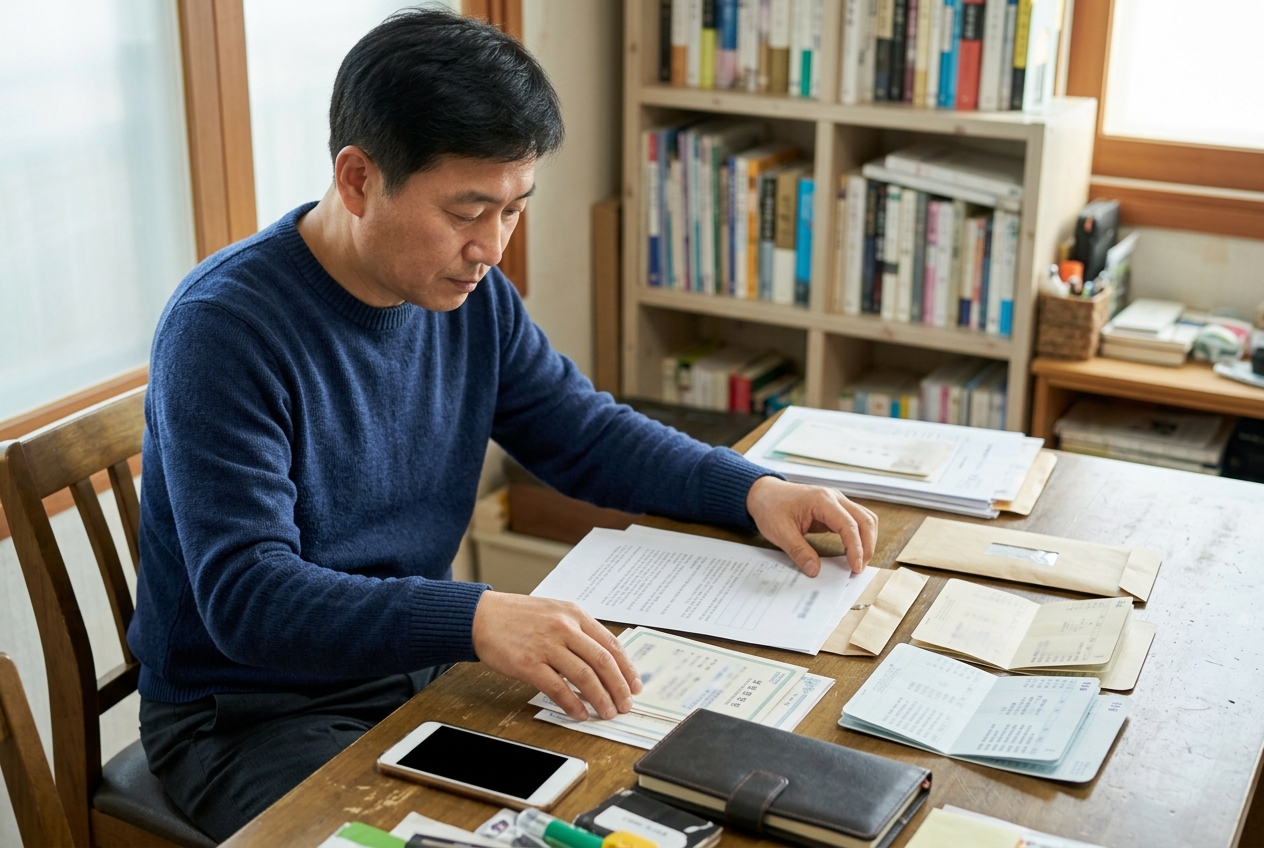
The response method varies depending on whether the deceased had a plan in place. If there is a will, you must first verify its validity, and the procedure may be simplified depending on whether it was notarized. If there is no will, assets are divided according to the inheritance order under the Civil Act. At this time, agreement among the heirs is more important than anything else.
After the death, you must proceed with name change procedures for each financial institution. Since the deceased's deposit accounts are frozen immediately after the death is reported, the consent of all heirs is required. You must prepare in advance as the seal certificate and power of attorney of all heirs are required. In addition, credit card cancellation, telecommunications service cancellation, and the organization of various membership services must be carried out sequentially. For digital assets, you should be aware that cryptocurrencies, online game items, and photos and documents in cloud storage on the deceased's smartphone or PC can also be subject to inheritance. Since the legal protection scope for such digital legacies is often not yet clear, delegating management rights in advance through a will can be a safeguard for the future. Recently, it is also necessary to check digital legacy management services or the legacy account management policies of each platform.
Additionally, heirs may discover unexpected important documents or contracts while organizing the deceased's belongings. These documents can play a decisive role in determining the scope of inherited assets or proving debt relationships, so it is wise not to discard them carelessly during the organization process but to keep them for a certain period. In particular, insurance policies or investment-related documents that the deceased signed up for during their lifetime are of great help when creating an inventory of inherited assets later.
Precautions and Conclusion
The most important thing to emphasize in all procedures is 'do not rush, but strictly adhere to deadlines'. It is easy to make mistakes when filling out documents while in grief. In particular, documents related to name changes for financial assets or debt repayment are difficult to reverse once submitted. Please be sure to keep copies and proceed with major decisions only after sufficient discussion with family members.
If you need professional assistance, it is wise to use consultations from the Korea Legal Aid Corporation or nearby tax accountant or law offices. Since it is difficult for an individual to perfectly grasp all legal and administrative issues, receiving a review from an expert, even if it costs money, is the way to prevent greater economic loss in the long run. While honoring the deceased and handling practical matters, please also take good care of your remaining life. Everyone is bound to be bewildered in the face of a sudden farewell, but if you take the steps one by one, it is definitely possible to organize everything. It is necessary to communicate with family and experts rather than worrying alone. Finally, please remember that the inheritance procedure is not just a process of dividing assets, but an essential process for concluding the deceased's life and for the remaining family to return to their daily lives. Taking enough time to process your emotions and comfort each other after the paperwork is finished is the most important final step.
Frequently Asked Questions
Where should I report a death?
You can do so at the Eup, Myeon, or Dong community service center having jurisdiction over the deceased's address, and you must bring a death certificate or a post-mortem examination report.
What is the difference between renunciation of inheritance and qualified acceptance?
Renunciation of inheritance means completely abandoning the status of an heir, while qualified acceptance means paying off debts only within the scope of the inherited assets.
How do I check assets after a death?
If you use the 'One-Stop Inheritance Service' provided by the government, you can check the deceased's financial, land, vehicle, and other asset details all at once.
When must inheritance tax be reported?
It must be reported and paid within 6 months from the end of the month in which the death occurred.
How are assets divided if there is no will?
Heirs divide the assets by agreement according to the inheritance order and ratio stipulated by the Civil Act; if no agreement is reached, it must go through court mediation or litigation.