Health insurance premiums are an essential social security cost that every South Korean citizen must pay monthly. While many people simply view the premiums deducted from their monthly paychecks as 'money going out,' understanding how these costs are calculated can be the first step toward managing your household finances. Rather than simply concluding that 'paying more is a loss,' it is important to understand how health insurance premiums are applied differently based on your income level and employment status.
The health insurance premium assessment system is broadly divided into workplace subscribers and regional subscribers. Because the two systems have different criteria for calculating premiums, simply knowing which category you currently fall into and how it might change based on situational shifts can help you prevent unnecessary expenditures or unexpected 'premium bombs.' Today, we will take an in-depth look at the structure of health insurance premiums and summarize practical criteria for efficient management.
Key Differences and Understanding of Workplace vs. Regional Subscribers

To manage health insurance premiums efficiently, you must first understand the principles that determine your subscription type. For workplace subscribers, premiums are determined based on the monthly remuneration received by the employee, with the company covering half the cost. In contrast, regional subscribers have their premiums calculated by assigning points to income, assets, and vehicles.
Workplace subscribers undergo an adjustment process every April based on the previous year's income through the total remuneration report. In this process, if income increases, premiums rise, and if income decreases, you receive a refund. It is crucial to be aware that if non-employment income (interest, dividends, business income, other income, etc.) exceeds 20 million KRW per year, additional premiums are levied on that income. Many employees overlook this, often leading to surprise when they receive an unexpected additional premium notice.
On the other hand, for regional subscribers, when income is below a certain level, assets and vehicle ownership have a direct impact on premiums. The important point here is that one cannot say 'one subscription type is absolutely more advantageous.' The perceived burden of premiums varies completely depending on whether your income structure is centered on employment income or includes business or property income. Note that even if a regional subscriber has no income, they may still be charged a minimum premium if they own assets; this applies equally to retirees with no income.
Evaluation Criteria for Assets and Vehicles for Regional Subscribers
The largest portion of premium calculation for regional subscribers is the asset score. The score is calculated by taking the standard market value of owned real estate—such as houses, buildings, and land—and subtracting the deduction amount. Since separate deduction benefits apply to single-home households or non-homeowners, it is important to accurately report your housing status. Vehicles are also graded based on displacement and age, and the system has recently been improved to reflect premiums only when the vehicle value exceeds a certain amount. Therefore, keeping your asset and vehicle information up to date is the beginning of premium savings.
Step-by-Step Practical Strategies for Health Insurance Premium Management

Managing health insurance premiums does not simply mean reducing them, but rather preventing unnecessary overpayment by accurately reporting changes in your income and assets. Please utilize the following step-by-step process to achieve this.
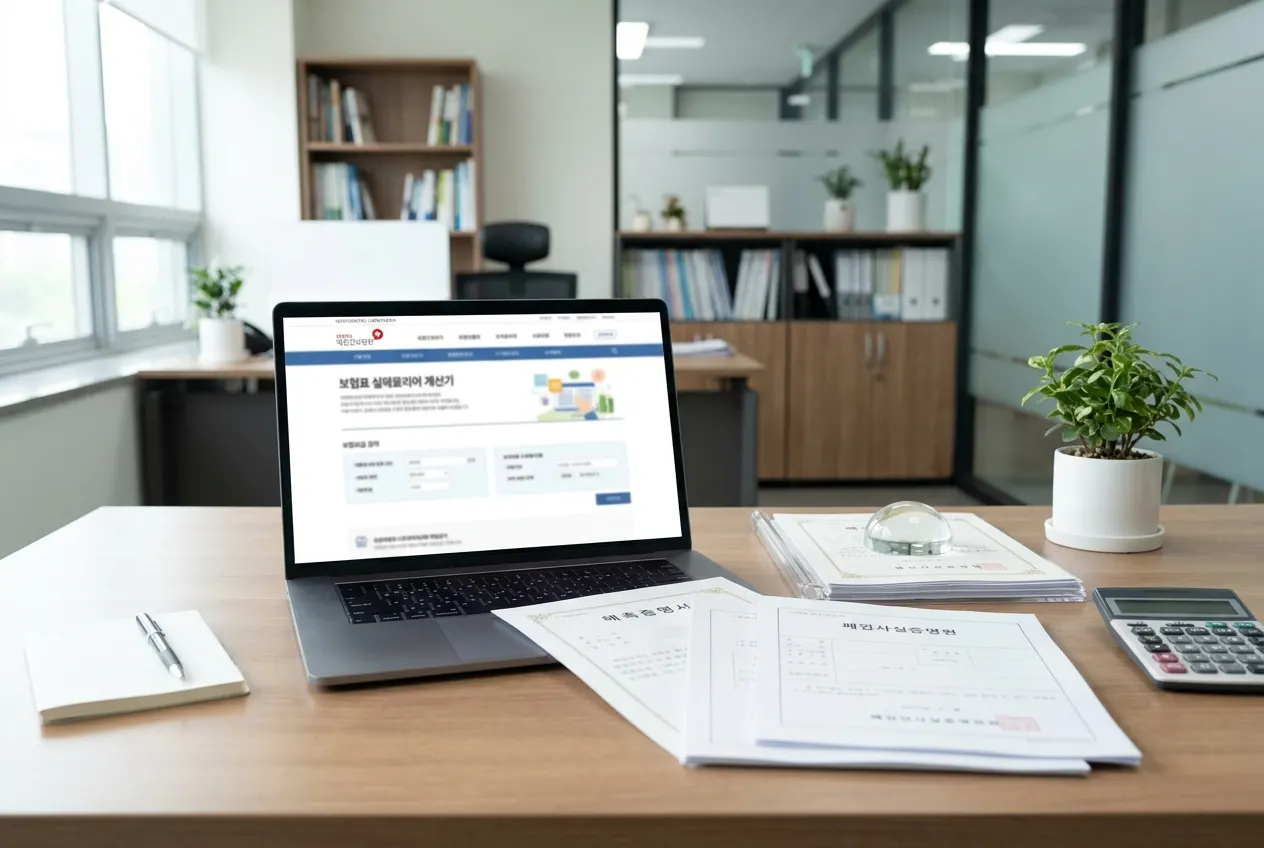
Step 1: Check your current subscription type and assessment criteria. You can use the 'Premium Simulation' menu on the National Health Insurance Service (NHIS) website to check your estimated premiums by entering your income and asset situation. In this process, you must clearly distinguish whether your income is employment income or comprehensive income including interest, dividends, and business income. If there is a discrepancy between the simulation results and the actual notice, contact your local NHIS branch immediately to verify the basis of the calculation.
Step 2: Proactively report changes in income. If you do not notify the NHIS of a decrease in income due to resignation or business closure, premiums will continue to be charged based on your previous income. You should prepare documents such as a 'Certificate of Resignation/Dismissal,' 'Certificate of Business Closure,' or 'Certificate of Income Amount' and apply for an adjustment immediately. For freelancers, submitting a Certificate of Resignation can be advantageous during income adjustment. Since the adjustment application takes effect from the point when income ceased, the key is to prepare the documents as soon as the reason for income reduction occurs.
Step 3: Regularly check eligibility requirements for dependents. If a family member's income increases or assets exceed certain criteria, their eligibility as a dependent may be revoked. Regularly check the requirements to prevent an unexpected conversion to a regional subscriber. In particular, since the dependent criteria require meeting both income requirements (e.g., annual combined income of 20 million KRW or less) and asset requirements (e.g., total tax base of 540 million KRW or less), you should check your eligibility status annually when the National Tax Service income data is finalized.
Step 4: Check asset and vehicle scores. For regional subscribers, houses, land, and owned vehicles subject to property tax are reflected in the premiums. Since vehicle scores vary by model year and displacement, considering the impact of these factors on premiums when replacing a vehicle is one strategy. In particular, disposing of an old vehicle or changing a vehicle to joint ownership can sometimes lead to premium savings.
Situational Considerations and Conditions Requiring Caution
As health insurance premiums are a fixed cost, they must be reviewed at important turning points in life. In particular, utilizing the 'Voluntary Continued Coverage' system after retirement is very important. If you are converted to a regional subscriber after retirement, premiums can rise sharply relative to your income; by applying for voluntary continued coverage, you can maintain the level of premiums you paid as an employee for a certain period (up to 36 months). This is a system that greatly helps in planning a stable life after retirement.
To apply for the voluntary continued coverage system, you must apply within 2 months of the payment deadline for the first premium notice received as a regional subscriber after retirement. If you miss this period, you cannot receive the benefits, so caution is required. Additionally, the conditions for maintaining dependent status are becoming stricter every year. You must carefully examine not only the income requirements but also the tax base criteria for assets. It is recommended to check your eligibility as a dependent annually, especially if you own a home under joint ownership or generate rental income. If there is a possibility of losing eligibility, you should include the costs that will arise upon conversion to a regional subscriber in your budget in advance.
Finally, remember that health insurance premiums are the foundation for the medical services provided by the state. Keep in mind that efficient management is not a 'trick to avoid paying,' but an 'exercise of rights to pay accurately according to my situation.' If you believe that excessive premiums are being charged, the legitimate way to handle it is to contact the NHIS customer center directly to verify your assessment details in detail and file an objection immediately if there is an error. In particular, because of the time lag in reflecting income data to the National Tax Service, premiums may be set higher than actual income, and in such cases, an active stance in explaining your situation is necessary.
Final Decision Criteria for Efficient Management

The criteria for effectively managing health insurance premiums are clear. First, is your income and asset information accurately reflected by the NHIS? Second, have you identified the premium differences that occur when changing subscription types in advance? Third, have you immediately reported changes such as retirement or income reduction? If you can confidently answer these three questions, you are managing your health insurance premiums well.
Premiums are closely linked to the nation's social security system. Therefore, it is necessary to have a habit of periodically checking relevant information whenever tax laws or health insurance-related laws are revised. Since the criteria for calculating premiums for regional subscribers often change every November, it is a good idea to check your assessment details around the end of the year. If you find it difficult to find information yourself, prioritize the notices provided by the National Health Insurance Service or the policy materials on their official website. Rather than relying on indiscriminate information, diagnosing your situation through official channels and seeking advice through direct consultation with the NHIS when necessary is the safest and most certain method. Finally, since health insurance premium payment records can be eligible for tax deductions during the year-end tax settlement, keeping your payment confirmation certificates is also a small tip for protecting your household finances. Such systematic management will serve as the foundation for maintaining a stable financial state.
Frequently Asked Questions
What happens to my premiums if I change from a workplace subscriber to a regional subscriber?
While workplace subscriber premiums are determined in proportion to income, regional subscriber premiums are calculated by considering not only income but also assets (real estate) and vehicles. Therefore, even if your income is low, your premiums may rise if you have significant assets.
Is there a way to reduce health insurance premiums after retirement?
If you are burdened by premiums after being converted to a regional subscriber upon retirement, try using the 'Voluntary Continued Coverage' system. You can pay the same level of premiums you paid at your workplace before retirement for up to 36 months, which can significantly reduce your initial burden.
How can I check my eligibility as a dependent?
You can check whether you maintain your eligibility as a dependent and verify your income/asset requirements through the 'Eligibility Check' service on the National Health Insurance Service website or by contacting the customer center.
When can I apply for a health insurance premium adjustment?
If your income has decreased due to business closure, dismissal, or retirement, or if your assets have decreased due to a sale, you can prepare supporting documents and apply for an adjustment at your local National Health Insurance Service branch.