The Canadian exchange rate is not just a change in numbers; it is a key indicator connecting the Canadian and Korean economies. Understanding the structural factors that determine the exchange rate allows you to go beyond simply asking 'is it cheap now?' and grasp 'why is it changing?'. Exchange rates are closely linked to interest rate differentials between the two countries, commodity prices—especially oil—and fluctuate in real-time based on global economic uncertainty. This article covers essential practical knowledge and strategies for asset protection when exchanging Canadian dollars.
Key Mechanisms of Canadian Exchange Rate Determination

The Canadian Dollar (CAD) is often classified as a 'Commodity Currency.' This is because the Canadian economy relies heavily on the export of natural resources such as crude oil, natural gas, and timber. When international oil prices rise, the Canadian economy is perceived as stronger, which tends to increase the value of the Canadian dollar. Conversely, when oil prices fall, the Canadian dollar tends to weaken.
Furthermore, the Bank of Canada's (BOC) benchmark interest rate decisions have a direct impact on the exchange rate. As the interest rate gap between the Bank of Korea and the Bank of Canada widens, capital movement occurs, which acts as the most powerful driver in determining the direction of the exchange rate. Rather than trying to predict the exchange rate, understanding the current interest rate trend and oil price movements is a great help in deciding when to exchange currency.
If you are sensitive to exchange rate fluctuations, you should develop the habit of checking charts for the trend over the last three months rather than just looking at the current rate. Long-term economic trends are more important than short-term volatility. In particular, the Canadian economy has a very close correlation with the U.S. economy. The ripple effect of policy changes by the U.S. Federal Reserve (Fed) on the Canadian dollar is also an essential factor to consider.
A point to check in the actual exchange rate determination process is 'market sentiment.' Even if economic indicators are good, if market participants are concerned about a future economic downturn, a preference for safe-haven assets may trigger, causing the Canadian dollar to weaken. Therefore, periodically checking the Consumer Price Index (CPI) and employment reports released in economic news is a fundamental skill for reading the flow of exchange rates.
Checklist to Verify When Exchanging Currency
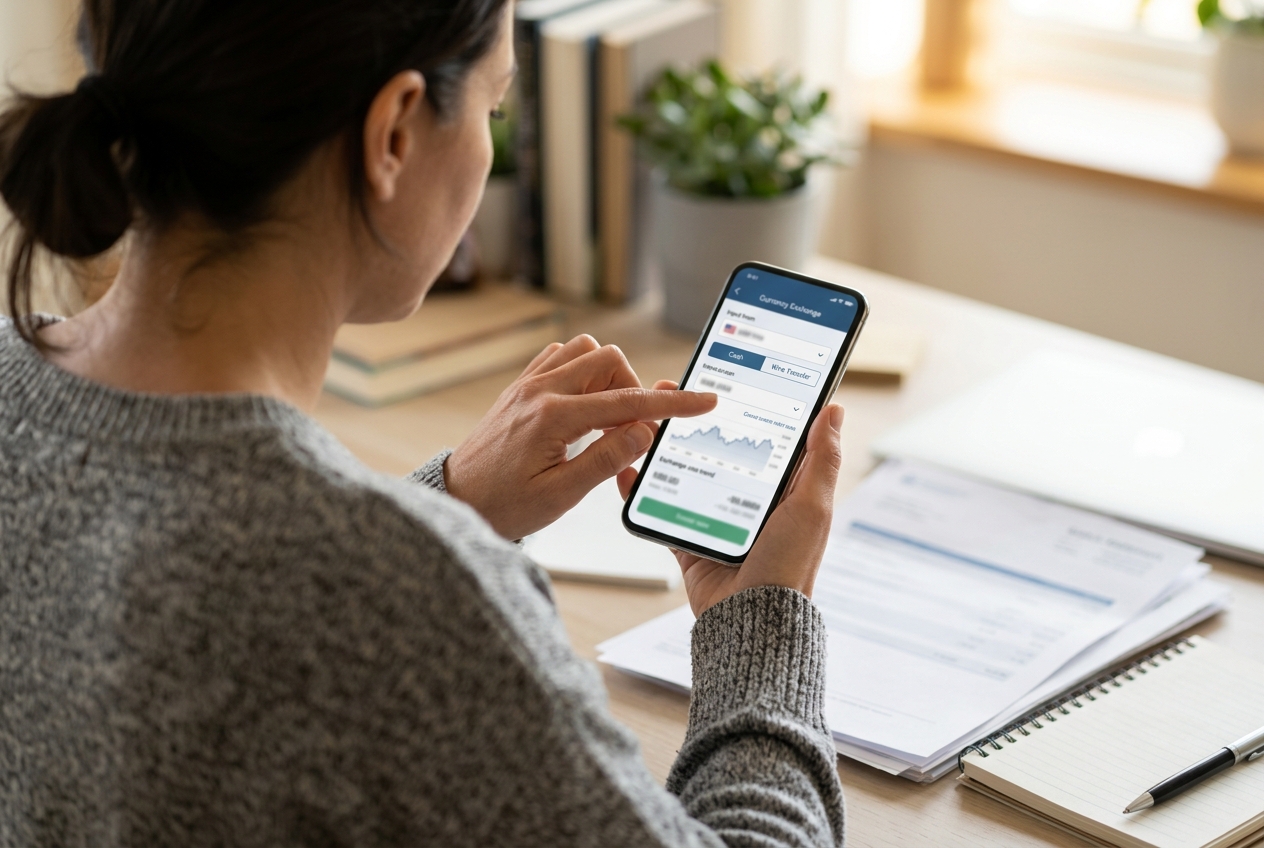
The biggest mistake when planning a currency exchange is overlooking fees. While the rates posted by banks may look similar, the actual 'spread' (the difference between the base rate and the actual exchange price) varies significantly. Here are the key items to check before exchanging currency:
- Preferential Exchange Rate: Verify if the preferential rate offered by the bank app or branch is actually applied. A preferential rate of 70-90% is generally standard.
- Transaction Time: Additional fees may apply for transactions outside of business hours. It is advantageous to use non-face-to-face exchange functions during business hours whenever possible.
- Split Exchange: Rather than exchanging a large amount at once, split it according to your purpose to diversify risk.
- Remittance vs. Cash: Cash exchange is generally more expensive than remittance due to storage and security costs. It is more cost-effective to minimize the cash you carry and use cards as your primary payment method.
The above items are essential, especially when preparing funds for studying abroad or overseas relocation. Small differences can lead to gaps of hundreds of thousands of won on large amounts. Using the 'exchange reservation' function in your primary bank's app is very useful, as it allows you to set it to automatically exchange when your target rate is reached. When exchanging, it is necessary to compare the bank's posted rate with the actual applied rate to calculate the real fee percentage.
As a precaution, be clearly aware that the exchange rate for 'buying cash' and 'sending a remittance' is different. Holding cash incurs management costs for the bank, so higher fees are charged. Therefore, if you plan to use a debit card locally, it is economical to limit cash exchange to a minimum emergency fund. Also, note that foreign exchange transactions are processed on a business-day basis, so real-time rate fluctuations may not apply on weekends or holidays.
Exchange Strategies by Situation: Travel vs. Study Abroad vs. Business

For travelers, using a credit card locally is often the most efficient method. Many debit cards with no overseas transaction fees have been released recently, making them safer and more economical than carrying large amounts of cash. However, you must prepare a small amount of cash for emergencies. It is also a good strategy to get a card that waives fees when using local ATMs.
On the other hand, students or long-term residents need regular remittances. In this case, consider fintech-based overseas remittance services instead of standard bank remittances. These often bypass the traditional banking network, offering lower fees and the ability to check rates in real-time. However, you must verify that the service provider is trustworthy and registered with the Financial Supervisory Service of Korea. For regular remittances, it is also recommended to deposit funds into a dollar savings account when the rate is favorable and send them when needed.
The most important criteria for selection are 'transaction frequency' and 'amount.' For travelers who need frequent overseas payments, choosing a card product with no exchange fees is the right answer. For students who need to send large sums, you must calculate the total cost, including remittance fees, telegraphic transfer fees, and intermediary fees. Some banks offer preferential remittance services for students, so actively utilizing these is also a good method.
Business-related currency exchange involves large scales, so the risk of exchange rate fluctuation is very high. In this case, you may need to consider 'forward exchange' contracts or currency hedging products. For corporate entities, consulting with your primary bank's foreign exchange specialist to find the optimal rate management solution is the standard approach. For large-scale capital movements, speed and security of the transfer are also important criteria alongside the exchange rate.
Practical Guidelines for Dealing with Exchange Rate Volatility

When exchange rates rise sharply, it is easy to feel psychologically anxious. The worst response is to panic and exchange currency without a plan. The safest strategy is 'split buying,' where you define your asset size and timing needs, and exchange only a portion of the required amount first. Do not try to beat market volatility; instead, be flexible enough to adjust your funding schedule according to market flows.
As a practical method, first, actively use 'exchange rate alert services.' Major financial apps provide alerts when a specific target rate is reached. Second, utilize 'foreign currency deposits.' If you buy dollars in advance when the rate is low and put them in a foreign currency savings account, you can drastically reduce the exchange rate burden when you need to send money later. This is a type of 'exchange tech' strategy and an effective means of hedging exchange rate volatility.
Financial market experts advise not to try to time the market, but to respond to it. The same applies to the Canadian exchange rate. Understanding your own cash flow and developing the habit of accumulating small amounts whenever the rate is favorable is the way to achieve the lowest average exchange rate in the long run. Financial transactions should always be cautious, and when dealing with large amounts, be sure to fully check relevant laws and bank policies. Keep in mind that the foreign exchange market is open 24 hours a day, and international issues occurring overnight are immediately reflected in the next morning's rate. Checking the schedule of major economic indicator releases through newsletters or financial app notifications is also a good way to prepare for exchange rate fluctuations. Finally, since foreign exchange transactions can involve the risk of principal loss, the wisest approach is to base your exchange plan on actual demand rather than investment purposes.
Additionally, 'psychological management' is more important than anything else during periods of exchange rate volatility. Rather than being swayed by daily exchange rate charts, sticking to a split-exchange principle within your planned budget reduces mental fatigue and helps you make more rational decisions. Experts emphasize strategies to lower the 'average unit price' when exchanging. Exchanging all funds at once is like gambling, so splitting the exchange over a period can significantly offset the risk of rate fluctuations. This systematic approach serves as a foundation for stably managing life abroad or overseas business.
In conclusion, the Canadian exchange rate is the result of complex economic variables. While it is nearly impossible to predict perfectly, if you understand the key factors and establish an exchange strategy tailored to your situation, you can reduce unnecessary costs and manage your assets efficiently. Based on the checklist and situation-specific strategies summarized today, we hope you make the most advantageous choice for yourself. Thorough preparation is the first step toward increasing the defensive power of your financial assets.
Frequently Asked Questions
Where is the cheapest place to exchange Canadian dollars?
Using the preferential exchange rate via your primary bank's mobile app is the most common method, and for larger amounts, it is recommended to compare fees on fintech overseas remittance platforms.
What is a preferential exchange rate?
It means the bank reduces a certain percentage of the profit margin (spread) that occurs when exchanging currency; a higher preferential rate is more favorable to the customer.
Is the Canadian dollar related to oil prices?
Yes, because Canada is a major crude oil exporter, the value of the Canadian dollar tends to rise when international oil prices rise due to expectations that the Canadian economy will improve.
Is it better to carry a lot of cash when traveling abroad?
Considering the risk of loss and exchange fees, it is safest and most efficient to carry only the necessary amount of cash while using a debit card with no overseas transaction fees.
How do I use the exchange reservation service?
This is a function that allows you to set a target rate in your bank app, and the exchange is automatically executed when that rate is reached, which is good for responding to sharp exchange rate fluctuations.