The New York stock market is more than just the U.S. stock market; it is a key indicator that determines the flow of capital worldwide. Many investors check the closing status of the New York market every morning because its movements have an immediate ripple effect on both domestic markets and the global economy as a whole. However, if you start investing without a precise understanding of why and how the New York market moves, you are likely to be swayed by market noise. The New York market is the world's largest pool of liquidity, and centered around the New York Stock Exchange (NYSE) and NASDAQ, it reflects every variable of the global economy—including interest rates, inflation, and geopolitical risks—into prices in real-time. Therefore, understanding the New York stock market is equivalent to grasping the operating principles of the modern economic system.
What are the 3 major indices you must know to understand the New York stock market?

The three major indices representing the New York stock market are the Dow Jones Industrial Average (DJIA), the S&P 500, and the NASDAQ Composite. Since each index has a distinct calculation method and composition, it is important to distinguish between them when interpreting market conditions.
First, the Dow Jones Industrial Average (DJIA) consists of 30 blue-chip companies representing the U.S. It uses a price-weighted method, meaning the index tends to react more strongly to changes in companies with higher stock prices. While it shows the most historical and traditional market sentiment, its limited number of stocks makes it less effective at immediately reflecting technological advancements or changes in industrial structure. Second, the S&P 500 includes 500 large-cap blue-chip companies listed on the U.S. market. Calculated by market capitalization, it is considered the most accurate reflection of the U.S. stock market's flow and is widely used as a benchmark for institutional investors' portfolios. Investors prioritize the S&P 500 when evaluating the overall health of the market. Third, the NASDAQ Composite is a technology-focused market. With many innovative growth companies listed, it is highly volatile but serves as a gauge for future growth potential. Because it has a high weighting of companies leading technological innovation—such as Apple, Microsoft, and NVIDIA—it is useful for identifying market risk appetite.
Index Comparison Checkpoint: Investors should choose an index based on their investment style. If you are conservative, observe the trends of the Dow Jones or S&P 500; if you prioritize growth, watch the movements of the NASDAQ closely. In particular, since the S&P 500 acts as a 'barometer' for the overall health of the economy, beginners are encouraged to develop the habit of gauging the general market atmosphere through the daily fluctuations of the S&P 500.
What are the decisive factors that move the New York stock market?

The fluctuations of the New York stock market are not determined solely by the performance of individual companies. The most influential variable is the monetary policy of the Federal Reserve (Fed). The base interest rate is like gravity for the capital market. When interest rates rise, the cost of corporate financing increases, which tends to lead to a decrease in net profit and a decline in stock prices. Conversely, when interest rates are cut, liquidity in the market increases, acting as a positive signal for the stock market.
Additionally, employment indicators and inflation rates (CPI, PPI) are essential factors that cannot be overlooked. If employment is robust, it signals that consumption is maintained and the economy is solid; however, if it is too 'hot,' it can stimulate inflation and dampen expectations for interest rate cuts. The market prefers a 'moderately good economy.' There is a constant effort to find a state where growth does not stop while prices do not rise excessively. Thus, the New York stock market repeats the process of constantly seeking balance between the two axes of 'economic data and policy expectations.' Practical investors should always keep in mind that market volatility can increase at the time of the monthly employment report and Consumer Price Index (CPI) releases.
Market Volatility Response Strategy: To avoid being flustered by sudden fluctuations immediately after indicator releases, you must check the gap between 'expectations' and 'actual results.' The market often does not react to already expected figures or has already priced them in. Instead, the market reacts strongly when a 'surprise' or 'shock' occurs—where results are lower or higher than expected. Therefore, checking the consensus of economic data released each month is the first step in practical response.
How can investors utilize New York stock market information in practice?
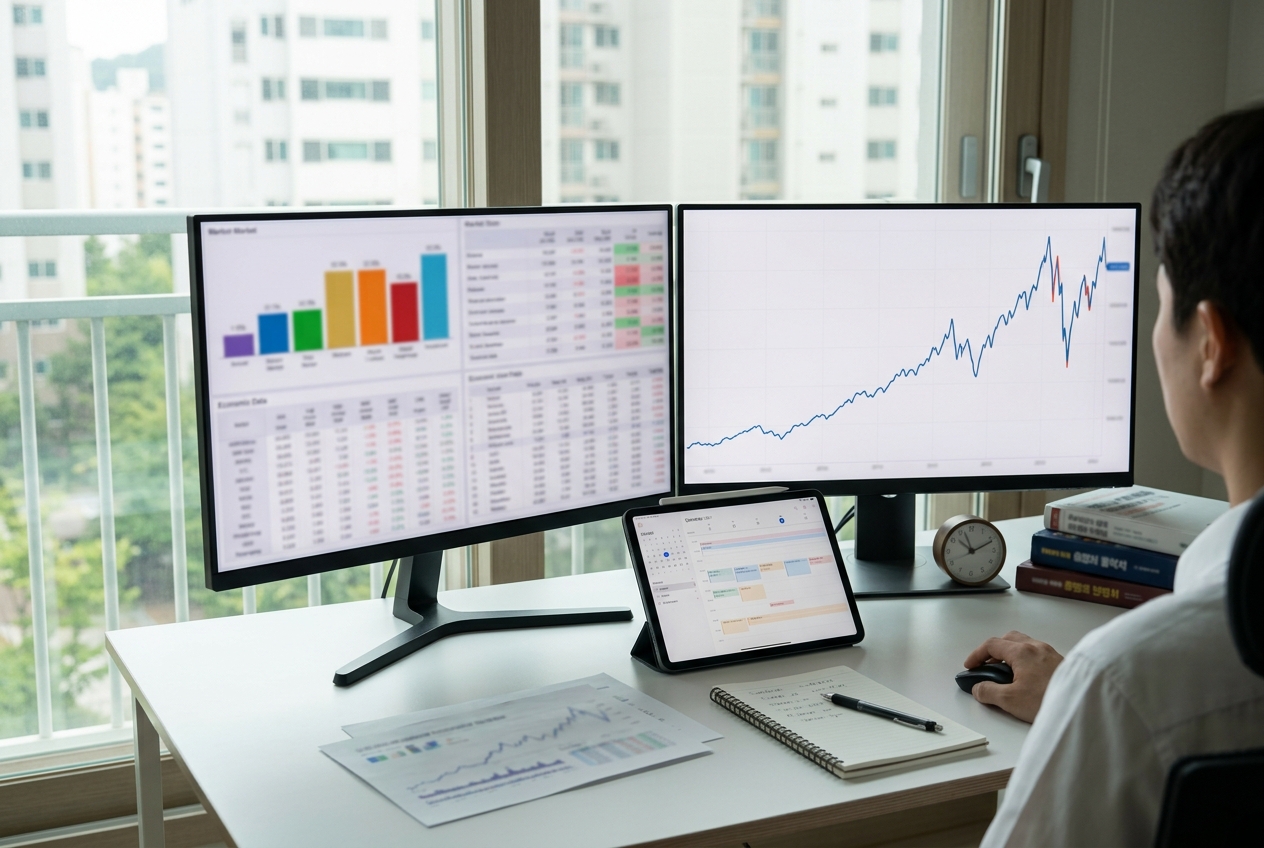
You should not consume New York stock market information merely as news headlines. To become a practical investor, you must make the following three checkpoints a habit.
First, check the major economic calendar. FOMC meeting schedules, Consumer Price Index (CPI) release dates, and employment report release dates are days when market volatility is maximized. You must identify these dates in advance and manage the risks in your portfolio. Since the market reacts immediately depending on how much economic indicators differ from expectations, you should be wary of volatility immediately after data releases.
Second, understand sector rotation. The market does not always see the same stocks rising. Rotation occurs, such as energy or financial stocks rising when tech stocks undergo a correction. This is because investors' preferred assets change according to the economic cycle. Rather than focusing only on a specific sector, you need an eye for observing where the overall market capital flow is moving. For example, when there are concerns about an economic recession, consumer staples or utility sectors gain attention, while tech or consumer discretionary stocks show strength during an economic expansion.
Third, use volatility as an opportunity. The New York stock market repeats sharp declines and surges in the short term. However, it has shown a historical pattern of trending upward in the long term. Rather than making emotional trades swayed by short-term noise, the priority is to verify whether the intrinsic value of the companies you have invested in has been damaged. Systematic investing (dollar-cost averaging) is one of the most effective ways to turn such volatility into an opportunity to lower your average purchase price.
Practical Implementation Method: Check the weighting of your portfolio every week. If your assets are concentrated in a specific sector, rebalancing is necessary to adjust the weight according to the market's rotation flow. For example, a representative strategy is to realize some profits and move them to defensive sectors if tech stocks are in an overheated state.
What are the points and strategies you must be careful about when investing in the New York stock market?

There is an additional risk of exchange rate fluctuations in overseas stock investment. Even if stock prices rise, if the exchange rate falls significantly, your returns in local currency (KRW) could become negative. Therefore, a strategy of diversifying exchange rate risk through split buying is necessary. Since short-term prediction of exchange rates is very difficult, a strategy of participating in the market consistently to take the average of exchange rate fluctuations is effective.
Also, you must be wary of information asymmetry caused by time differences. There are many cases where people react excessively when events that happened overnight are reflected in the domestic market the next day. Rather than unconditionally applying the closing situation of the New York market to the opening of the domestic market, critical thinking to judge whether the issue is temporary or structural is essential. Simply dumping stocks today because the U.S. market fell yesterday may be a hasty judgment. You need training to distinguish whether the issue damages the company's fundamentals or is merely a change in market sentiment.
Finally, caution is required regarding leverage or inverse products. In a volatile market, leverage products can cause losses to snowball due to the compounding effect if held for a long time. Beginners should focus on ETFs that track indices, and when investing in individual stocks, they should cultivate the habit of carefully checking the quarterly earnings reports of those companies. The New York stock market is the heart of the global economy. Do not dismiss what happens there as merely external factors; instead, use it as the most important compass to protect and grow your assets. Only when you comprehensively consider everything from basic index composition to the correlation of economic data and exchange rate volatility can you achieve investment that does not waver.
Caution: Unexpected 'black swans' can occur in financial markets at any time. Do not assume unconditional rises just because certain indicators are good, and maintaining a certain portion of cash to have the capacity to respond during market crashes is the strategy of a true expert. Also, remember that during earnings season, a company's guidance can act more importantly than its net profit.
Financial investment carries the risk of principal loss, and the content of this article is for reference only. Please consult with an expert or proceed with caution under your own responsibility for specific investment decisions.
Frequently Asked Questions
What are the closing hours of the New York stock market?
Based on U.S. Eastern Time, the regular session closes at 4:00 PM. In Korean time, it closes at 5:00 AM or 6:00 AM, depending on whether daylight saving time is in effect.
Why is the S&P 500 index the most important?
Because it consists of 500 large-cap blue-chip stocks that represent the entire U.S. market, it best reflects the overall market atmosphere and economic situation.
If the New York stock market falls, does the domestic stock market always fall?
Generally, they show a high correlation, but that is not always the case. It can react differently depending on the performance of domestic companies or individual economic situations.
What is the easiest way for a beginner to invest in the New York stock market?
If choosing individual stocks is difficult, split buying into ETFs that track the S&P 500 or NASDAQ 100 index is the most popular and stable method.